In the video clip below it shows Carl Barton, extracting many snakes everyday to obtain the precious venom that can be used in the medical field for anti venom. Even though venom is seen to be dangerous, it can have advantages that save people lives.
We all knew that anti venom could save your life when you were bitten, but even if you were not bitten or stung by a venomous creature, venom could end up saving your life in the long run. With today's medical advances, scientists and researchers have discovered the advantages of venom to help with cancer, tumors and controlling someones blood pressure. In this NOVA special, Kate Becker blogs on the different venomous species that can both kill and save us.
A scientist named Empu Gong and his team examined a preserved skull of the dinosaur Sinornithosaurus in 2009. They discovered that the dinosaur Sinornithosaurus, Chinese bird-lizard, had a venom gland near its teeth. Looking closer at this characteristic it showed that it was the same gland that is connect to the teeth of many of the venomous snakes.
It is suggested that Sinornithosaurus used its venom to paralyze its prey and begin to eat it while the victim was still alive. In the picture below it shows that this particular dinosaur looks just like a raptor, but also has feathers like a bird. All of the feathers on its body are different. The feathers near the head are thin and feather like, while the feathers on its main body and near its very long tail are thick and express the pattern of wings of todays birds.
Since Sinornithosaurus has feathers like birds and we know birds are descendants to dinosaurs, do you think that there is a possibility that there a venomous birds? Is this even possible because they have beaks instead of fangs? Is there another way that they can deliver venom to its prey without a bite?
When the topic of venom comes up, the two creatures that are thought of the most would be snakes and spiders. But has a Platypus, Octopus, or Stone fish ever crossed your mind?
Only male Platypus's have the venom glands, females do not. According to research scientists, the main reason why they produce venom in their spurs (located underneath the flippers) is to go against the other males during the mating season. No worries though because the venom is usually not venomous.
Another amazing creature to add to the venomous list would be the Blue- Ringed Octopus. Their beaks are sharp enough to pierce through a wet suit, and they have enough venom within them to kill about 26 people within 15 minutes. It can both squirt and bite to deliver venom to its victim.
The stone fish is definitely not a looker but it has venomous spines that release when pressure is added to their backs. The number one reason why people get stung by this fish is because they mistake it for a rock and step on it. Instead of using its venom to capture its prey, scientist believe it to be used primarily as a defense mechanism.
Do you think these animals are more dangerous because of the fact that not too many people know that they are venomous? Does that put them at a higher threat to people?
Sources:
Aquariumpix- Photoblog for the saltwater and reef aquarium hobbyist. Upclose with a stone fish. posted 21
May 2010. accessed 25 April 2011.
Backshall, Steve. Venomous Animals of the World. Baltimore: The Johns Hopkins University Press.
2008. Print. 25 April 2011.
Blue- ringed Octopus. posted 30 September 2010. accessed 25 April 2011.
The Animal Welfare Crisis. Platypus. posted on 8 January 2007. accessed 25 April 2011.
Below is a clip i found of the most venomous snake in the world, The Inland Taipan. Not to be confused with its cousin the Costal Taipan. This snake posesses enough venom to kill about "250,000 mice and, by extrapolation, 100 people!" (Backshall 120).
The King Cobra, on the other hand would be the longest venomous snake. They tend to be on the shy side but when threatened they stand tall and spread their hoods to appear larger and scary. The mating ritual is kinda bizzare for these snakes. The male dances around the female and twists all over her body before actually mating. Once some time passes the snakes make a nest for the young and guard it at all costs. The female King Cobras are some of the best mothers in the animal kingdom. Below is a clip of a King Cobra being held in captivity.
Just for fun, i would love to share this clip with everyone. This is from a movie i used to watch when i was little. It is called Rikki- Tikki- Tavi, and you probably have seen it or heard of it before. The action begins when a mongoose named Rikki is adopted into a home when the family saves him from a flood. While out patrolling the garden he is presented with the threat of Nag, a big black cobra. Naturally, the mongoose puts up a fight with a cobra and can defend themselves with their agility. Though everyone would enjoy this!
*You can stop at 1:50, but i recommend watching the whole movie =) *
Sources:
Backshall, Steve. "Venomous Animals of the World." The Johns Hopkins University Press/ Baltimore.
2007: pg. 120.
"Big, Bad King Cobra" TexasOnTheWildSide. 23 April 2008. Video. 20 april 2011.
Kipling, Rudyard. "Rikki Tikki Tavi Part 2 of 3" The Jungle Book. 20 Aug 2008. Video. 20 april 2011.
According to Steve Backshall, author of the book "Venomous Animals of the World", he states that there are many different kinds of venom, but there are two that are far more popular and used than the others. They are called Neurotoxins and Haemotoxins.
Haemotoxins affect red blood cells and anything to do with the cardiovascular system. In very severe cases, without the venom being treated, the victim can experience internal bleeding
Neurotoxins are you guessed it! deals with the nerves and the nervous system. This enables the animal to move because the nerves transmissions are messed up causing paralysis.
Here is a link for the NOVA: Venom- Natures Killer (your more than happy to watch the whole clip)
-but for these special types of venom that i talked about above go to 10:21/53:06 this breaks down to show you how the body is affected when bitten or stung, while also showing this battle with the venom in real people.
Which once do you guys think would be the worst. Dying from internal bleeding, with your red blood cells being destroyed, or being paralyzed with the risk of suffication? Which do you think is the most common in snakes since they can use their venom to affect a victim both ways?
Sources:
Backshall, Steve. "Venomous Animals of the World." Baltimore: The Johns Hopkins University Press.
2008. Print. 15 April 2011.
NOVA -Venom: Natures Killer. (Video) 23 Febuary 2011. PBS. 15 April 2011.
**(BTW- the beginning scared the crap out of me cause my speakers were really loud =) just giving a warning )**
Another contender that we can add to the list would be the Black Widow Spider. Not an agressive type, except if you were its mate, these spiders wont bite you unless you want to step on them. It bite is lethal and is very painful. It has beautiful markings but even though they are wonderful to look at, those markings mean a warning to anything that dares come near it.
Black Widow Spider: Photobucket. picture from Goregod51
what do you guys think? do you think that the spiders ancestor posessed venom glands? which route do you think researchers tend to look at for the detection of the venom glands in ancestors? Or did the characteristic of the venom glands develop over time as a dominant trait?
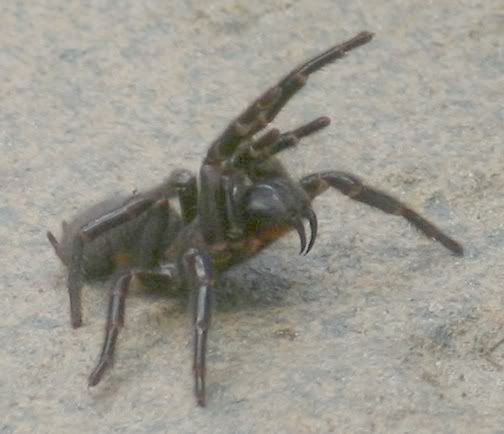
This is the baddest of the bad. The Sydney Funnel-Web Spider, is definitely thought to be on the most lethal arachnid list. They can be very aggressive when provoked and when they decide to use their venom they not only strike once but repeatedly with their sharp fangs (about the size of a cats claw!) Even though the male is quite smaller than the female, his venom is "4-6 times more toxic and dangerous."
The Brazilian Wandering or Banana Spider, are particularly dangerous because they dont seem to mind being in areas where the human population is high. They dont mind, just as long as they get their dose of cockroaches and crickets. So, your probably wondering why they are called banana spiders? Well, when the natives of Brazil would collect banannas to take all over the world, the spiders would hang in the tress and eventually get a free ride. Their venom "results in immediate pain, cold sweats, excessive salavation, cardiac perturbations which leads to death."
For those who chose the jellyfish as the most venomous out of the three, you are correct! Just like snakes and spiders, jellyfish are hard to spot. The number one most dangerous animal when it comes to venom would be the box jellyfish. The severity depends on the size, and number of tenticles of the jellyfish.
But not all venomous animals have to be snakes, spiders or jellyfish. There are a number of many different types of species and varieties of animals that use toxins for a defence mechanism or to kill/stun their prey. We can sub categorize the animals to their specific classes to learn more about which species has the venomous characteristics. These include the Arachnides, Cephalopods, Cnidaria, Fish, Insects and Reptiles.
If you were an animal that didn't have any appendages, teeth or claws how could you defend yourself on this unforgiving planet? Without the advantages of speed or strength you probably wouldn't last long in this predator/prey environment.
Although this can be proven wrong by many species that have the advantage of chemical and biological warfare. Even though you may not have the teeth of a Great White Shark, or the speed of a cheetah, you possess the most dangerous weapon of all. Venom.
But what exactly is venom? What happens when it gets into your body? And most importantly, how can it be stopped before its too late. Venom can be described as a variation of toxins that are secreated from animals mainly through a bite or a sting.
There are many different types of species that are venemous but out of these three: snakes, jellyfish, or spiders, which one do you think is the most venemous?